Brandflight

The 4D School

A way of seeing brands that has lasted twenty-five years — and is still being written.

4D Branding began in Stockholm at the turn of the millennium. It changed how a generation of European companies understood what a brand is for. This page is where it came from, what it says, and who is carrying it forward.

It started with a book — and a foreword from Richard Branson

In 2001, Financial Times Prentice Hall published 4D Branding: Cracking the Corporate Code of the Network Economy. Thomas Gad wrote it. Richard Branson wrote the foreword. Within a few years it had been translated across Europe and Asia and had become one of the more quietly influential branding books of its decade.

Gad came to the subject from twenty years in advertising — among other work, the line "Connecting People" for Nokia was his. He had grown impatient with how the industry described brands: as logos, as campaigns, as a tone of voice. None of it explained why some brands lasted and others, equally well-funded, did not.

His answer was that a brand is not a thing a company owns. It is a relationship — and like any relationship, it lives in more than one dimension at once. He counted four.
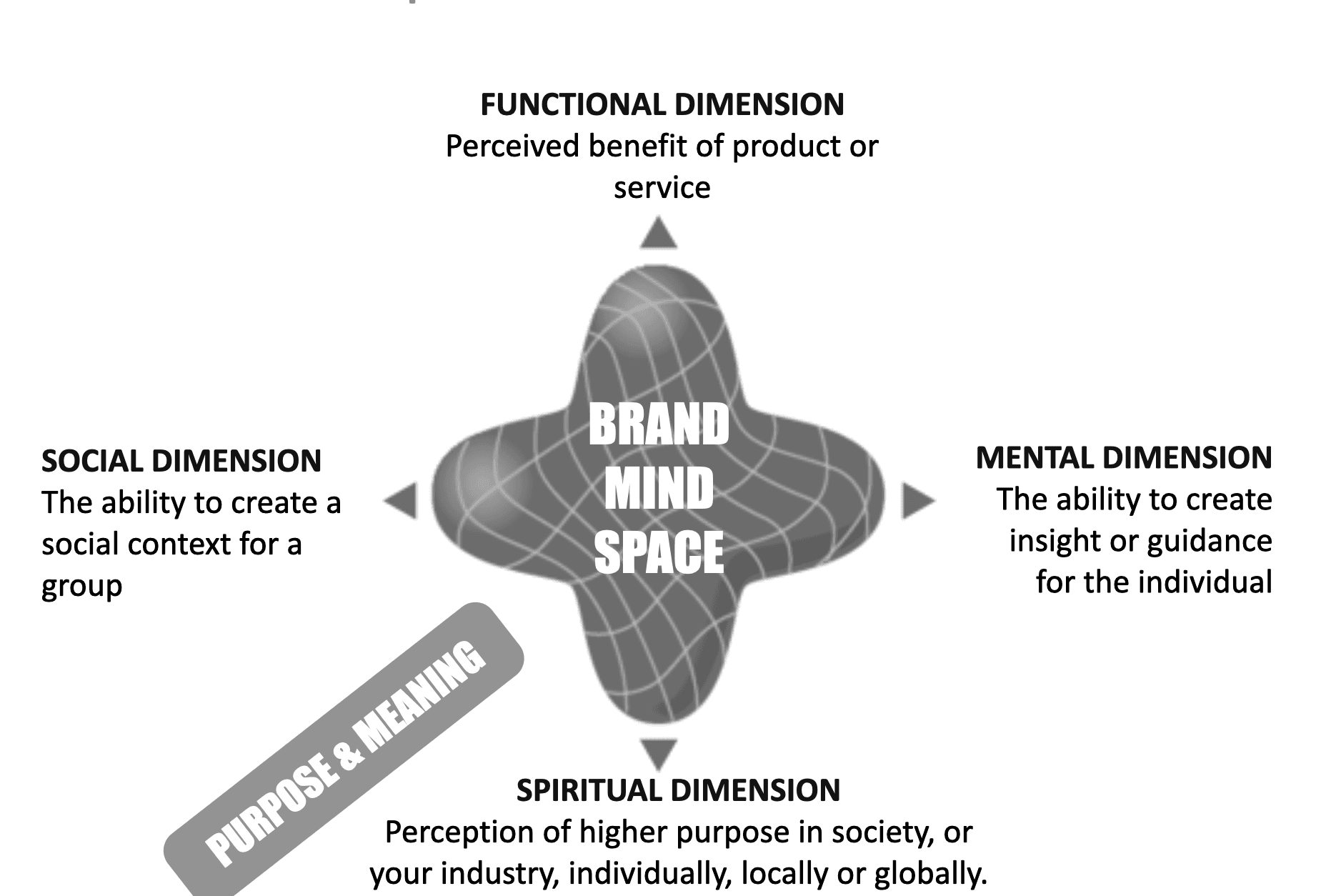

Four dimensions, one brand

The argument at the centre of 4D Branding is simple to state and hard to live up to: every brand exists in four dimensions at the same time, and the durable ones are coherent across all four. Most brands are strong in one, passable in a second, and absent in the other two. Gad called the complete picture the Brand Mind Space.

1

Brand Mind Space

The functional dimension

What the brand actually does — the quality, the performance, the practical usefulness of the product or service.

Then: a place to win. Do something better and you had a brand.

Now: the floor, not the ceiling. Function is copied within a quarter and, increasingly, automated. A brand that lives only here has no protection left.

2

Brand Mind Space

The social dimension

What the brand says about the people who choose it — the group it signals belonging to.

Then: status and aspiration.

Now: community and values. The most visible of the four, and the most volatile — it is where brands are championed, and where they are boycotted.

3

Brand Mind Space

The mental dimension

What the brand does inside a person — how it changes the way someone sees themselves, and what it helps them become.

Then: the most overlooked of the four.

Now: arguably the most valuable. In a crowded, anxious market, the brands that help people author their own sense of self are the ones that are genuinely hard to replace.

4

Brand Mind Space

The spiritual dimension

The brand's role in the larger system — its responsibility to the society and the planet it operates in.

Then: a forward-looking idea, ahead of its audience.

Now: simply expected. What the book called the spiritual dimension, the market now calls purpose, ethics, and sustainability — and treats as non-negotiable.

A brand that holds all four — useful, identifying, self-transforming, and responsible — is what Gad meant by a 4D brand. It is still the most useful test we have.

Editorial portrait of Annette Rosencreutz

A practice built by two people

A book is one thing; a practice is another. The 4D model became a working method because it was used — on real companies, with real stakes — and that work was done in partnership.

Annette Rosencreutz was Thomas Gad's partner in work and in life for more than fifteen years. She edited 4D Branding itself. With Gad she co-authored Managing Brand Me (2002), the book that took the four-dimensional idea and turned it on the individual — the first serious treatment of what the world would later, less carefully, call personal branding. And across more than a decade of consulting, she was the one who carried the framework into boardrooms: applying it, pressure-testing it, and translating it for companies across Europe and the United States.

The methodology has one author. The practice had two.

The school today

Thomas Gad died in 2016. Annette has carried 4D Branding forward since — not as an archivist of someone else's idea, but as the person now responsible for keeping it honest.

That means using it where the questions are hardest: with private-equity-backed companies under pressure to reposition; with leaders working out what a brand even means in the age of generative AI; with European businesses rebuilding after the pandemic; and with a generation of executives who never read the original books and shouldn't have to in order to benefit from them.

The four dimensions have not changed. What they require of a company in 2026 has. Keeping that distinction clear — what is permanent in 4D, and what has to be re-thought every few years — is the work of the school now.

Placeholder: Thomas Gad photo

Licensed real photo required before launch.

On Thomas Gad

Thomas Gad 1951–2016 was a Swedish brand strategist, the originator of 4D Branding, and a founder of the Medinge Group. He spent his career arguing that brands were a humane subject — about meaning and belonging, not manipulation — and was generous to almost everyone who asked him about it. 4D Branding is his idea. This site exists, in part, to make sure it keeps being used well.

The 4D School — the origin and continuation of 4D Branding | Brandflight